Updated Mitigation Measures - SIMP

Document

PDF 310.50 KB

EIS Frequently Asked Questions

1. What is a bilateral agreement and how does it relate to HumeLink?

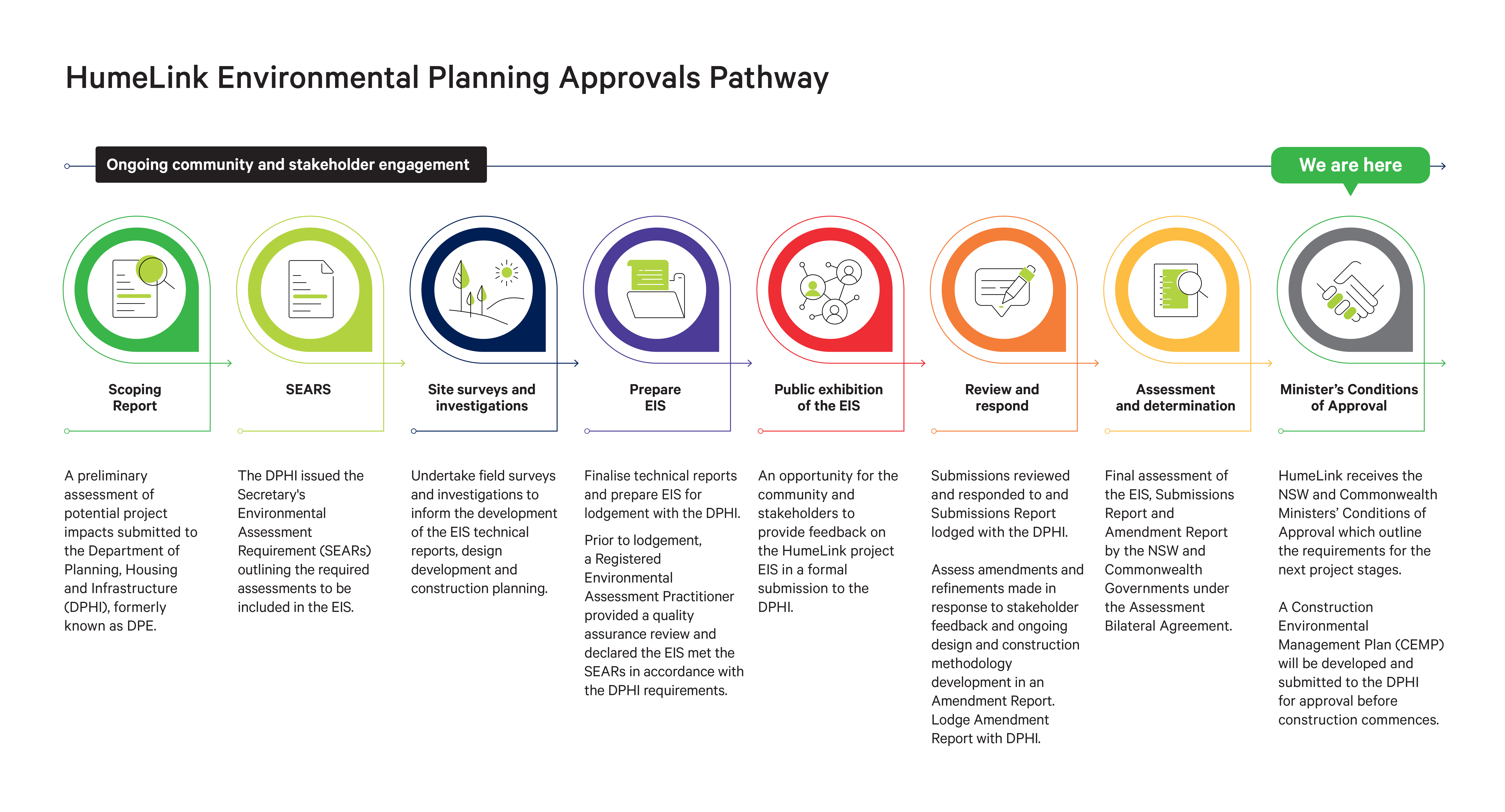
HumeLink’s EIS was developed to satisfy the requirements from both the State and Commonwealth governments assessment under a bilateral agreement. This agreement is established between the Commonwealth and NSW governments to strengthen co-operation and reduce duplication during certain environmental impact assessment processes. The approach is standard practice for Critical State Significant Infrastructure (CSSI) projects. Under this agreement, some planning stages will be carried out in parallel.

2. What is an Environmental Impact Statement (EIS)?

As a Critical State Significant Infrastructure (CSSI) project, HumeLink is required to develop an EIS. An EIS describes in detail the environmental, social and economic impacts that can arise from the project and proposes measures to effectively mitigate those impacts. 

As part of the planning approval process for HumeLink, an EIS was prepared in accordance with the Planning Secretary’s environmental assessment requirements (SEARs). The SEARs identify matters which must be addressed in the EIS and essentially form its terms of reference. 

3. What are the Secretary’s Environmental Assessment Requirements (SEARS)?

The Department of Planning, Housing and Infrastructure (DPHI) issued the Secretary's Environmental Assessment Requirements (SEARs) for the HumeLink project in March 2022. In April 2022, the supplementary SEARs, which include Commonwealth Government requirements, were issued.

The DPHI included input from relevant government agencies to consider their requirements for the project before issuing SEARs. The SEARs identify and specify matters which must be investigated as part of the EIS and essentially form its terms of reference. It includes the requirements for both the NSW and Commonwealth governments.

The key issues outlined in the SEARs and supplementary SEARs include biodiversity (threatened species and communities and migratory species), heritage (National Heritage places), water and soils, land, transport, amenity, air, hazards, waste, social and economic.

4. How much feedback was received on the Environmental Impact Statement (EIS) and how was it used?

Transgrid received and responded to 158 submissions from government agencies, local councils, organisations and individual community members on the EIS.

The Submissions Report responds to the submissions made during the public exhibition period. It explains who made submissions, what issues they raised and directs the submitter to additional information, where relevant.

After considering issues raised in the submissions, as well as stakeholder feedback before and during the public exhibition, and design and construction methodology development, Transgrid is proposing several amendments and refinements to the project. These changes are detailed in a separate Amendment Report, which describes any different or new impacts arising out of the proposed amendments and refinements and how those impacts would be managed and mitigated. 

To find out more about HumeLink’s Submissions Report and Amendment Report, access and view the Submissions Report and Amendment Report tab in the Regulatory and Environmental Approvals section of the website.

5. Who has been engaged during the development of the EIS?

Adhering to the EIS engagement process for proponents of major infrastructure projects, Transgrid consulted with the relevant local, State and Commonwealth Government authorities, service providers, community groups, affected landowners, Native Title holders and Aboriginal land claimants, exploration licence holders, quarry operators and mineral title holders.

6. How has Transgrid engaged with impacted landowners during the development of the EIS?

Transgrid has a dedicated team of place managers and land access officers who have built direct relationships with impacted landowners throughout the project footprint. The place managers and land access officers have one-on-one and ongoing engagement with landowners about their properties. During the development of the EIS, our team members directly engaged with landowners to discuss the key aspects of the EIS, opportunities for feedback and the next steps in the environmental approvals process.

7. How were the stakeholders engaged during the EIS public exhibition?

Transgrid undertook a range of engagement activities during the public exhibition period to inform landowners, the community and other stakeholders about the project, discuss concerns and questions, and provide information on how to make a formal submission on the EIS.

The HumeLink team held 22 community information sessions across the project footprint and three webinars. The team also visited landowners with the Remote Access Community Hub (RACH), held additional sessions for Community Consultative Group (CCG) members, and promoted our activities extensively across local media, in our newsletters and updates. The HumeLink July 2023 Newsletter was emailed to more than 800 project subscribers, easement-affected landowners and near neighbours, local information distributors, CCG members and letterbox dropped to more than 11,000 recipients within a 10-kilometre radius of the EIS project footprint.

Printed copies of the main body of the EIS were also available at select community libraries across the project footprint and posted to landowners on request. A digital EIS (DEIS) was developed to support a better understanding of the HumeLink EIS. The user-friendly and interactive platform presented key outcomes of the EIS, delivering interactive mapping, multimedia displays and links to the full EIS on the NSW Major Projects Planning Portal. During the EIS public exhibition, the DEIS received 18,270 views with 1,500 active users visiting the HumeLink Digital EIS portal.

More information is available in the What We Heard Report (September/October 2023).

8. Was the EIS assessed with other documents?

Yes. Transgrid lodged HumeLink’s Submissions Report, Amendment Report, the revised Biodiversity Development Assessment Report (BDAR), the NSW Biodiversity, Conservation and Sciences group (BCS) submission on the EIS and the Enabling Works Management Plan (EWMP) with the NSW Department of Planning, Housing and Infrastructure (DPHI). All submitted reports were read and assessed in conjunction with the EIS for final determination on the project.

9. What’s in the HumeLink Submissions Report?

The Submissions Report collates, categorises and provides a response to submissions received on the EIS. 

Submissions from government agencies, public authorities and local councils were considered separately to submissions from the community and organisations. The content of each government agency, public authority and local council submission was reviewed, and each issue raised has been included and responded to in the Submissions Report. 

The content of each community and organisation submission was reviewed and categorised according to the key issues raised (e.g. economic, environmental, and social impacts) and sub-issues (e.g. biodiversity). These issue-specific categories formed the basis for the structure of responses to the submissions. The key issue categories were generally developed to be consistent with the Department of Planning, Housing and Infrastructure (DPHI) State significant infrastructure guidelines - preparing a submissions report (DPE, 2022a). 

10. What’s in the HumeLink Amendment Report?

HumeLink’s Amendment Report  outlines project changes since publication of the EIS, and helps the community, government agencies and the Department of Planning, Housing and Infrastructure (DPHI) understand the implications of these changes. The HumeLink Amendment Report assesses several amendments and refinements in response to issues received on the EIS, ongoing design refinements and further construction planning. 

The amendments and refinements provide refinements to the design and construction methodology of the project. Several technical reports have also been prepared to support the assessment of the proposed amendments and refinements. These are provided in HumeLink’s Amendment Report. 

11. What are the amendments & refinements in the HumeLink Amendment Report?

The proposed amendments in the Amendment Report include:  

  • changes to the transmission line corridor including the realignment of the route through Green Hills State Forest to the west of Batlow  
  • changes to the number and location of construction ancillary facilities including worker accommodation facilities and construction compounds  
  • nomination of access tracks to support the construction and operation of the project  
  • additional telecommunications connections to existing substations.  

The proposed refinements in the Amendment Report include:   

  • transmission line and substation design refinements at Gregadoo  
  • identification of areas where controlled blasting may be required 
  • use of approved water sources  
  • use of helicopters and drones.  

Find more information on the proposed amendments and refinements, along with the technical reports to support the assessment of the proposed amendments and refinements on the NSW Major Projects Planning Portal.

Certain components of these reports, including the revised Biodiversity Development Assessment Report (BDAR) and other information related to biodiversity (such as updated environmental mitigation measures and the response to the NSW Biodiversity, Conservation and Sciences group (BCS) submission on the EIS) were also lodged to the DPHI in June 2024.

12. How were stakeholders engaged following the EIS public exhibition?

Transgrid engaged the community and stakeholders following the EIS public exhibition and during preparation of the Amendment Report by undertaking in-person and online engagement advertised through print, digital newspaper and social media advertisements, posters in local towns and email campaigns. 

In the lead-up to lodging the Amendment Report and Submissions Report, the project team held 15 in-person community information sessions and five webinars to discuss the project’s proposed amendments and refinements. The project team also completed 15 street meetings with the Remote Access Community Hub (RACH) at locations near the proposed combined worker accommodation facilities and construction compounds. The property and engagement teams – via our place managers and land access officers – managed ongoing direct engagement with impacted landowners and near neighbours on the proposed amendments and refinements and their potential impacts. 

The project team also engaged with Aboriginal stakeholders and Registered Aboriginal Parties (RAPs), Community Consultative Groups (CCGs), local councils, government agencies, mineral title holders and the general community. 

More information on our engagement can be found in the What We Heard Reports on the Community information sessions section of the website. Our engagement for the Amendment Report is also detailed in Chapter 5 of the Amendment Report and in Appendix D: Engagement Outcomes Report, available on the NSW Major Project Planning Portal.

13. What's next?

The HumeLink project received approval for its EIS from the NSW Department of Planning, Housing and Infrastructure (DPHI) and the Commonwealth Department of Climate Change, Energy, the Environment and Water (DCCEEW) in late 2024. This approval was subject to specific Conditions of Approval which outline how potential impacts and community engagement must be managed throughout construction and operation.

To ensure ongoing compliance with the project’s Conditions of Approval, Transgrid published the HumeLink Biodiversity Offset Package, the Phased Deliverables and the Enabling Works Management Plan. The Construction Environmental Management Plan (CEMP), detailing HumeLink’s construction methodology and impact mitigation strategies, was submitted to and approved by the DPHI prior to the commencement of main construction activities.

Site establishment and early works for the project started in early 2025. Main construction work on transmission lines and substations began in September 2025.

We will continue to work with communities and all local stakeholders throughout construction and we are committed to keeping them informed as the project progresses. We will also continue to prioritise local employment, provide training and skills development to build the workforce and focus on lasting community benefits.

EIS Fact sheets

A series of detailed technical studies and reports were completed as part of the EIS. The EIS fact sheets provide a summary of key technical studies, the methodology we used to identify and assess potential project impacts, our findings and how we manage or minimise them. Please note these fact sheets were published for the Environmental Impact Statement public exhibition and the information may have been updated since.