Overview

The Hunter has long played an essential role in powering NSW.  It is a region shaped by energy, industry, agriculture, local communities and a strong connection to land and place. 

The Hunter Transmission Project is a major NSW Government initiative involving EnergyCo, Transgrid and specialist delivery partners. As the project moves towards delivery, you will begin to see Transgrid take on responsibility for delivering the project, working within the NSW Government’s project framework and planning approval.  

Transgrid will oversee detailed design and delivery and, once the project is complete, safely operate and maintain the infrastructure over its full life.  

Working with EnergyCo and specialist delivery partners, we will help carry forward the knowledge, questions, concerns and commitments people have already shared. 

While the Hunter Transmission Project is new, Transgrid’s connection to the Hunter is not. For more than 70 years, our people have lived and worked across the region, helping operate and maintain the essential transmission infrastructure that communities rely on every day. 

We will continue to listen, explain decisions clearly and work to reduce avoidable impacts.  
Why is the project needed?

The way electricity is generated and used across NSW is changing.

As older power stations retire, the transmission network needs sufficient capacity to move electricity from different generation sources to the places where it is needed. The Hunter Transmission Project will help address this network need by strengthening the connection between Bayswater and Eraring.

The project will help:

  • Maintain energy security as older power stations retire 
  • Improve the reliable movement of electricity across NSW 
  • Increase electricity transfer capacity through the Hunter 
  • Strengthen the existing transmission network 
  • Support changing electricity demand 
  • Connect electricity from new generation and storage projects  

This project will support the region’s evolving contribution within a changing electricity system. 

About the project

The Hunter Transmission Project is a major NSW Government infrastructure initiative to strengthen the backbone of the NSW electricity network and support the reliable movement of electricity across the state. EnergyCo has led the project’s planning, environmental assessment and consultation. 

The project includes: 

  • A new overhead 500 kilovolt double-circuit transmission line of around 110 kilometres 
  • New switching stations at Bayswater South and Olney 
  • Adjustments and upgrades to existing transmission lines 
  • Access tracks, road upgrades, construction support sites and other facilities needed to deliver the project  

The project will help increase the capacity of the network as older generation sources retire and the way electricity is generated and used changes. It will support energy security by helping electricity move reliably between generation sources and the homes, businesses, industries and essential services that depend on it.  

Project snapshot

  • Approximately 110 kilometres of new overhead transmission line 
  • 500 kilovolts of double-circuit transmission infrastructure 
  • Bayswater to Olney connecting existing parts of the NSW transmission network 
  • Long-term responsibility: Transgrid will oversee detailed design and delivery, then operate and maintain the infrastructure.

Project map

Understanding where the project will be delivered 

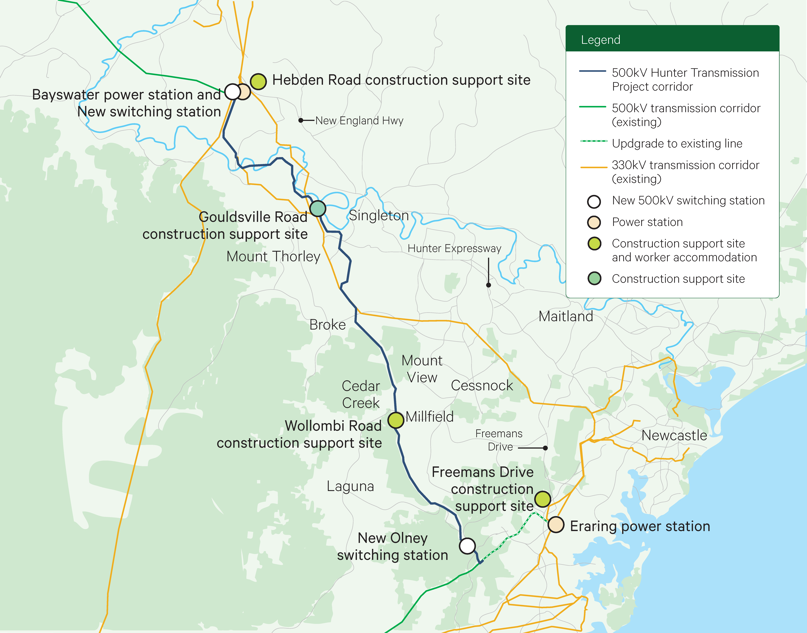
The project extends from Bayswater in the Upper Hunter to Olney in the Lower Hunter, where it connects to the existing transmission network near Eraring. 

The corridor runs through different landscapes and communities across the Hunter. Between Bayswater and Broke it is predominantly located within mining, energy and government land. It then continues through the Pokolbin, Corrabare, Watagan and Olney State forests before connecting to the existing 500 kilovolt transmission line.  

What planning approval means

EnergyCo has led the Hunter Transmission Project's strategic planning, corridor selection, environmental assessment and consultation. The project has received NSW and Commonwealth planning approval. It will now move into detailed design, engineering, management planning and other work required before major construction begins.

Planning approval defines the approved project corridor and establishes the conditions that must be met as the project is designed, delivered and operated.

There are still opportunities for local knowledge to inform aspects of practical delivery such as: 

  • Timing and coordination of activities 
  • Construction traffic and local roads 
  • Biosecurity and agricultural operations 
  • Environmental management 
  • Cultural values and heritage 
  • Construction impact mitigation 
  • Rehabilitation and property-specific mitigation 

As detailed design progresses, the project team will explain what can still be influenced, what has already been determined through planning approval, and why. 

How the project is being delivered

Each organisation involved has a different role in planning, overseeing and delivering the project. 

EnergyCo 

EnergyCo is the NSW Government infrastructure planner responsible for the project. It has led strategic planning, corridor selection, environmental assessment and public exhibition, and retains responsibility for project governance, government and agency relationships, and oversight of whole-of-project commitments.  

Transgrid 

Transgrid is the project’s network operator. Working within the NSW Government’s project and approval framework, Transgrid will manage detailed design and delivery oversight and, once the project is complete, operate and maintain the new infrastructure as part of the NSW transmission network.  

Delivery partners 

Specialist delivery partners, Downer for transmission line infrastructure, and UGL for switching stations and substation upgrades, will undertake construction activities and provide day-to-day information and engagement about their work, including notifications, enquiries, complaints and liaison with affected landholders and communities.  

EnergyCo, Transgrid and the delivery partners will coordinate their work, share relevant information and provide clear ways for people to ask questions or raise concerns. 

What happens next

The next phase will focus on detailed design, engineering, investigations, management plans and other work required before construction begins. 

Transgrid, with the project team, will share information before activities occur, explain what is known and what is still being worked through, and provide clear opportunities for people to contribute local knowledge. 

We will also close the loop by explaining: 

  • What we have heard 
  • How feedback has been considered 
  • What has changed as a result 
  • What commitments are being carried forward 
  • Where something cannot change, and why 

Local knowledge will help the project team plan work more carefully, identify potential impacts earlier and develop practical ways to reduce disruption wherever possible. 

Our connection to the Hunter

For more than 70 years, Transgrid’s people have lived and worked across the Hunter, operating and maintaining the transmission infrastructure that helps power homes, businesses, industry and essential services. 

Much of this essential work happens behind the scenes. It includes inspecting and maintaining infrastructure, working with landholders, preparing for emergencies, protecting environmental and cultural values, and keeping electricity flowing safely and reliably. 

This experience gives us a practical understanding of the different communities, industries and landscapes that make the Hunter unique and shapes how we approach the Hunter Transmission Project.  

Working with landholders

As detailed design and construction planning progress, our engagement teams will work directly with affected landholders to work through property-specific considerations and discuss planned activities. 

This includes matters such as: 

  • Property access arrangements 
  • Farming and business operations 
  • Biosecurity 
  • Easements and existing land use 
  • Timing of investigations and construction 
  • Traffic and movement of equipment 
  • Environmental and cultural values 
  • Rehabilitation and impact mitigation 

Landholders will receive advance notice before property investigations, access requirements or project activities occur. 

Our role is not simply to notify landholders about activity. It is to understand their operating environment, reduce avoidable impacts, and ensure work is planned and undertaken with local conditions in mind. 

Environment, biodiversity and cultural values

The project crosses landscapes with significant environmental, biodiversity and cultural values. 

Environmental requirements established through the planning process will continue into detailed design and delivery. 

First Nations engagement will continue throughout the project. Transgrid will work with relevant Local Aboriginal Land Councils, Traditional Owners, knowledge holders and other stakeholders, with opportunities to inform project design, delivery and community outcomes.  

Learn more about the project’s planning documents and Environmental Impact Statement and environmental planning and corridor selection 

Learn more about First Nations engagement for the Hunter Transmission Project. 

Project Timeline - Where are we now?

  • Planning and environmental assessment - Completed

    Corridor development and refinement | Technical and environmental studies | Environmental Impact Statement | Public exhibition and submissions | Project amendments and planning assessment

  • Planning approval - Completed

    Project corridor approved | Conditions and delivery requirements established

  • Transition to the Network Operator - In progress

    Transfer of project information and commitments | Transition of stakeholder relationships | Establishment of Transgrid engagement channels | Appointment and mobilisation of Delivery Partners

  • Detailed design and investigations - Proposed

    Engineering and site investigations | Property and access planning | Environmental and cultural heritage work | Preparation of management plans | Continued landholder and community engagement

  • Minor works and main construction - Proposed

    Road upgrades | Site establishment | Access and preparatory works | Transmission line and switching station construction | Ongoing notifications and engagement

  • Operation and maintenance - Proposed

    Long-term operation of the infrastructure | Maintenance and asset management | Continuing relationships with landholders and communities

Staying informed

We will share project information before relevant activities occur and explain what people can expect as detailed design and delivery progress. 

You can: 

  • Subscribe for project updates 
  • Read project newsletters 
  • Explore project documents and fact sheets 
  • Attend community information sessions 
  • Speak directly with the project team 
  • Ask a question or raise a concern 
  • Provide local knowledge and feedback 

Subscribe for project updates

Register to receive project information, announcements, advance notice of relevant activities and opportunities to get involved. 

Contact the project team

Phone: 1800 606 298
SMS: 0461 460 614 
Email: htpcommunity@transgrid.com.au 
Mail: Hunter Transmission Project Community Engagement Team, PO Box A1000, Sydney South NSW 1235

Hunter Transmission

23 November 2026

Jobs and lower-cost energy one step closer as Hunter Transmission Project moves into delivery

Transgrid today welcomed its appointment by the NSW Government as Network Operator of the Hunter Transmission Project - critical state significant infrastructure designed to strengthen NSW’s electricity network that supports millions of homes, businesses and industries.

Hunter Transmission

29 January 2025

Transgrid and EnergyCo sign agreement for Hunter Transmission Project

Transgrid has welcomed a commercial agreement with the NSW Government for the Hunter Transmission Project, which is a critical next step as the state transitions to a cleaner, more affordable electricity supply.